Compressed Air Poly Pipe: The Engineer's Guide to Smarter, Safer Industrial Air Systems
Ask any engineer who has managed a compressed air system for more than a few years, and they'll have a story. A leak that nobody could find for months, quietly bleeding pressure and inflating the electricity bill. A galvanised steel pipe that corroded from the inside, shedding rust particles into the air stream and fouling pneumatic tools and equipment downstream. An installation that took weeks and a small fortune in labour to complete, only to need significant rework when the facility layout changed twelve months later.
Compressed air is one of the most widely used utilities in industrial and manufacturing environments, and also one of the most poorly managed. The piping system that delivers compressed air around a facility is foundational to everything that depends on it — and yet it's frequently specified, installed, and maintained as an afterthought. For engineers and project managers overseeing facility builds, upgrades, or expansions, the choice of compressed air piping material is more consequential than it might appear on first glance.
Aluminium and steel pipes have been the default for decades. But compressed air poly pipe engineered polyethylene pipe specifically designed for compressed air distribution, has emerged as a compelling alternative that addresses many of the practical shortcomings of traditional materials. This guide examines what poly pipe for compressed air actually is, where it excels, how it compares to conventional materials, and what engineers and project managers need to know to make an informed specification decision.
Why the Choice of Compressed Air Piping Material Matters
Compressed air systems are expensive to run. Across the Australian industry, compressed air is estimated to account for between 10 and 30 per cent of total electricity consumption in facilities that use it extensively. A significant proportion of that energy cost — in poorly maintained systems, potentially 20 to 30 per cent of total compressed air generated — is simply lost to leaks.
The piping system is a primary driver of leak rates. Joints, fittings, and pipe material all contribute. Older galvanised steel systems are particularly prone to corrosion-related leaks as they age, and the threaded joints used in traditional steel installations are inherently more leak-prone than modern push-fit or compression fitting alternatives. Aluminium systems perform better on corrosion resistance but can still present challenges around joint integrity over time, particularly in environments with vibration or thermal cycling.
Beyond leaks, piping material affects air quality. Internal corrosion in steel pipe produces rust particles and scale that contaminate the air stream — a significant problem in applications where air quality matters, including food and beverage production, pharmaceutical manufacturing, electronics assembly, and spray painting. The energy cost of compressing air that is then lost to leaks, the maintenance cost of managing corrosion, and the quality implications of contaminated air all flow directly from the choice of piping material.
For engineers specifying a new compressed air distribution system — or reviewing an existing one — these are not abstract considerations. They translate directly into energy costs, maintenance schedules, production quality, and equipment lifespan.
What Is Compressed Air Poly Pipe?
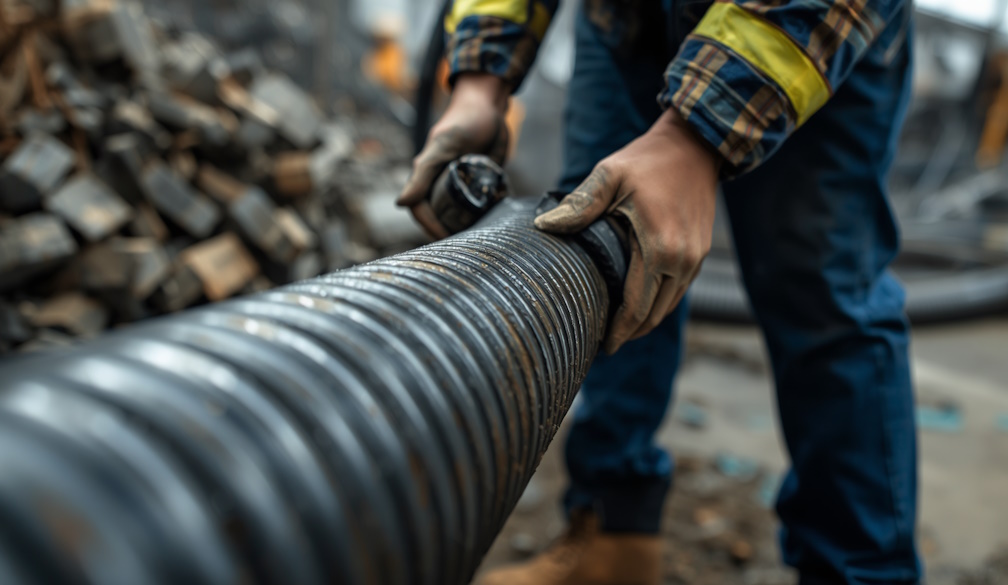
Compressed air poly pipe is high-density polyethylene (HDPE) or medium-density polyethylene (MDPE) pipe specifically engineered and rated for use in compressed air distribution systems. It is distinct from standard plumbing polyethylene pipe — which should never be used for compressed air — in that it is manufactured to pressure ratings, temperature tolerances, and quality standards appropriate for compressed air service.
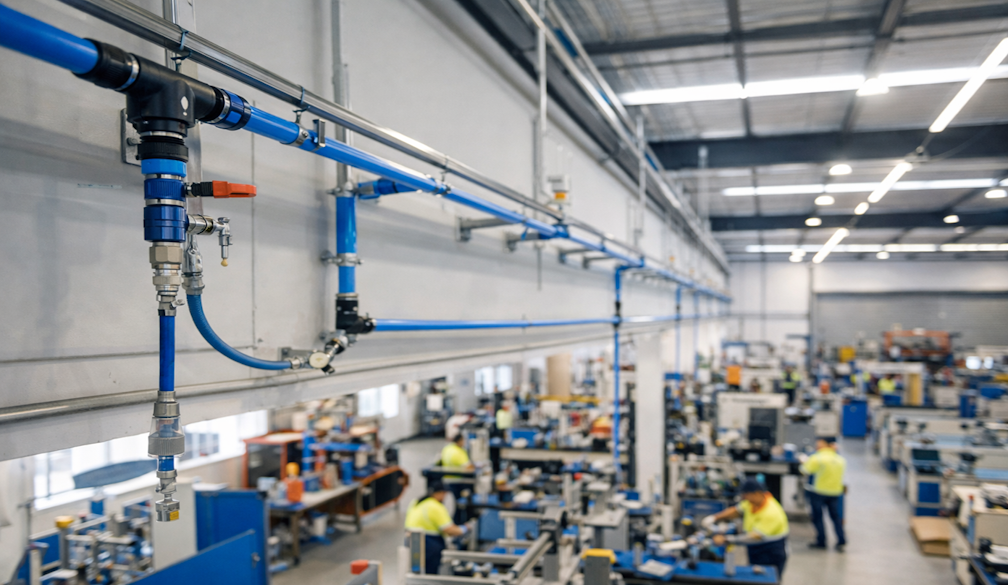
Purpose-built compressed air poly pipe systems typically include a matching range of fittings — elbows, tees, reducers, valves, and drops — designed to create a leak-minimised compressed air distribution network using push-fit or compression connection methods that require no threading, welding, or solvent cement.
The polyethylene material used in quality compressed air pipe systems is chemically inert, non-corrosive, and smooth-bored — meaning it doesn't rust, scale, or shed particles into the air stream. This makes it inherently well-suited to applications where air purity is important and where the internal degradation associated with steel pipe would otherwise require additional filtration and regular maintenance attention.
How Poly Pipe Compares to Steel and Aluminium
Understanding how compressed air poly pipe compares to the conventional alternatives helps engineers and project managers make a specification decision grounded in practical outcomes rather than habit or assumption.
Versus Galvanised Steel Pipe
Galvanised steel pipe has been the standard for compressed air distribution in the Australian industry for decades, and it remains widely installed in older facilities. Its advantages are familiarity and robustness — it's a known quantity, and it handles higher pressures and temperatures reliably.
The disadvantages, however, are significant and well-documented. Galvanised steel corrodes internally over time, particularly in the presence of moisture, which is always present to some degree in a compressed air system. Internal corrosion produces rust particles that contaminate the air stream, reduce effective bore diameter, and eventually lead to leaks at corroded sections and joints. Threaded steel joints are labour-intensive to install and inherently more leak-prone than modern connection methods. And modifying or extending a steel system — when the facility layout changes or production requirements evolve — is expensive and disruptive.
Poly pipe eliminates internal corrosion entirely, installs significantly faster, connects with push-fit fittings that are more reliably leak-free than threaded joints, and can be modified or extended with minimal disruption. For new installations and for the replacement of ageing steel systems, the operational case for poly is strong.
Versus Aluminium Pipe
Aluminium compressed air pipe systems represent a significant improvement over galvanised steel in terms of corrosion resistance and installation speed, and they have become increasingly popular in Australian industrial facilities over the past two decades. Aluminium doesn't corrode in the same way as steel, installs faster with push-fit or mechanical fittings, and produces a cleaner air stream.
Poly pipe competes directly with aluminium and offers some specific advantages in certain applications. Poly is generally lower cost than aluminium — both in materials and fittings — making it an attractive option for large-scale distribution networks where material cost is significant. Poly is also more flexible than aluminium, which simplifies installation in complex routing situations and reduces the number of fittings required to navigate obstacles. In applications where the pipe will be exposed to chemicals, solvents, or aggressive environments, the chemical resistance of HDPE is typically superior to that of aluminium.
Aluminium maintains advantages in high-temperature applications and where very high working pressures are required. The right choice between poly and aluminium depends on the specific application parameters — pressure, temperature, environment, scale, and budget.
Key Technical Considerations for Specifying Compressed Air Poly Pipe
For engineers and project managers moving from specification interest to actual project decisions, these are the technical parameters that matter most:
Pressure Rating
Compressed air poly pipe is available in different pressure ratings, and specifying the correct rating for the application is non-negotiable from a safety perspective. Most industrial compressed air systems operate at between 700 kPa and 1,400 kPa (7 to 14 bar). Quality compressed air poly pipe systems are typically rated to at least 1,200 kPa at 20°C, with de-rating factors applied as operating temperature increases.
Always confirm the pressure rating of the specific pipe and fitting system being specified against the maximum allowable working pressure of the compressed air system, including any surge or transient pressure events. Never assume that because a poly pipe product is marketed for compressed air use, it is rated for the specific pressure and temperature conditions of your application.
Temperature Limits
Polyethylene pipe has a lower temperature ceiling than steel or aluminium. Most compressed air poly pipe systems are rated for continuous service up to around 60°C, with some systems rated to higher temperatures. In most compressed air applications — where air is typically cooled after compression and the ambient installation temperature is within normal industrial ranges — this is not a limiting factor.
However, in applications where compressed air is used at elevated temperatures or where the pipe is installed in close proximity to heat sources, temperature ratings must be carefully evaluated. De-rating charts provided by the manufacturer should be consulted and applied.
Pipe Sizing and Pressure Drop
Correct pipe sizing is critical to compressed air system performance. Undersized pipe creates excessive pressure drop — meaning the compressor must work harder to maintain delivery pressure at the point of use, increasing energy consumption and reducing efficiency. An oversized pipe increases material cost unnecessarily.
Pipe sizing calculations for compressed air distribution should account for:
- Peak demand flow rate (litres per minute or cubic metres per hour)
- Pipe length and number of fittings (which contribute equivalent length for pressure drop calculation)
- Maximum acceptable pressure drop from the compressor outlet to the most remote point of use
- Future expansion requirements — it's almost always worth sizing for anticipated growth rather than current demand only
Ring main configurations — where the compressed air distribution loop forms a closed ring around the facility rather than a dead-end tree structure — significantly reduce pressure drop and improve flow balance, and are strongly recommended for larger facilities.
Fitting Selection and Installation Quality
The fittings used in a compressed air poly pipe system are just as important as the pipe itself. Push-fit fittings designed specifically for the pipe system being installed should always be used — mixing fittings from different manufacturers or using fittings not rated for the application is a common source of system failures and leaks.
Installation quality also matters considerably. Even the best poly pipe system will underperform if poorly installed — pipe not fully inserted into fittings, fittings not properly supported, pipe runs without adequate provision for thermal expansion and contraction, or inadequate isolation valves that prevent maintenance without shutting down the entire system.
Installation Advantages That Matter on the Project Schedule
For project managers, installation speed and disruption minimisation are as important as technical performance. Compressed air poly pipe delivers meaningful advantages on both fronts.
Push-fit poly fittings require no threading equipment, no welding, and no curing time — an experienced installer can make connections significantly faster than equivalent threaded steel joints, and without the hot work permits and fire watch requirements associated with welded connections. This matters in operating facilities where compressed air distribution work must be completed during scheduled maintenance windows or in sections to minimise production disruption.
The lighter weight of poly pipe compared to steel also reduces the physical demands of installation, particularly for overhead runs where pipe must be lifted and supported into position. Fewer personnel may be required for the installation, and the risk of manual handling injuries during installation is lower.
Poly pipe systems are also highly modifiable after installation. Adding drops, extending runs, or reconfiguring the distribution network as facility layouts or production requirements change is straightforward and inexpensive — a significant advantage over steel systems, where modifications require cutting, threading, and reassembly that is both time-consuming and disruptive.
Safety Considerations: Using the Right Product for the Application
A critical safety point that cannot be overstated: not all polyethylene pipe is suitable for compressed air service, and using the wrong product is genuinely dangerous.
Standard plumbing polyethylene pipe — including the blue poly pipe widely used for water supply in Australian residential and commercial construction — is not rated for compressed air. Compressed air stores significantly more energy than water at the same pressure, and the catastrophic failure of an inappropriately specified poly pipe under compressed air pressure can cause serious injury.
Only pipe and fittings that are specifically engineered, pressure-rated, and marketed for compressed air service should ever be used in a compressed air distribution system. Always verify the manufacturer's pressure rating, temperature rating, and application suitability documentation before specifying or approving any poly pipe product for compressed air use.
This is not an area where cost-cutting through substitution is acceptable. The price difference between a correctly specified compressed air poly pipe system and an inappropriately specified alternative is trivial compared to the consequences of a pressure system failure.
Maintenance and Lifecycle Considerations
One of the most compelling arguments for compressed air poly pipe from a lifecycle perspective is its low maintenance requirement. Unlike steel systems — which require periodic inspection for corrosion, treatment of corroded sections, and eventual replacement of sections that have deteriorated beyond serviceability — a well-installed poly system requires very little ongoing maintenance beyond regular leak detection and joint inspection.
For facilities where compressed air system maintenance is a recurring operational cost and disruption, the reduction in maintenance burden associated with a poly system can represent meaningful savings over the life of the installation. This should be factored into total cost of ownership comparisons with steel alternatives, where the lower upfront material cost of steel is frequently offset by higher lifetime maintenance costs.
Leak detection in poly systems is also simplified by the smooth external surface and visible joint connections. Ultrasonic leak detection — which is the most effective method for identifying compressed air leaks that are too small to hear — works reliably on poly pipe, and any leaks that do develop at joints are typically easy to locate and rectify.
Making the Specification Decision
For engineers and project managers evaluating compressed air poly pipe for a new installation or a system upgrade, the decision framework is relatively straightforward:
- Confirm that the operating pressure and temperature of the application fall within the rated parameters of the poly pipe system being considered — consult manufacturer data sheets and apply de-rating factors where necessary
- Evaluate the installation environment — chemical exposure, UV exposure for outdoor runs, ambient temperature extremes — and confirm suitability
- Complete a pipe sizing calculation based on peak demand, acceptable pressure drop, and anticipated future growth
- Design the distribution layout as a ring main where practical, with adequate isolation valves, condensate drains, and service drops positioned to support both current operations and future modifications
- Specify fittings from the same manufacturer as the pipe and verify that the complete system — pipe and fittings — carries the appropriate pressure rating
- Factor installation time, labour cost, and maintenance lifecycle into the total cost of ownership comparison with alternative materials
The Bottom Line for Engineers and Project Managers
Compressed air poly pipe is not a novelty — it is a mature, well-proven technology that has been successfully deployed in industrial and manufacturing facilities across Australia and internationally. For the right applications, it offers a combination of installation efficiency, long-term reliability, low maintenance burden, and air quality benefits that make it a genuinely compelling specification choice.
The key, as with any engineered system, is specifying the right product correctly for the specific application. That means verified pressure ratings, appropriate pipe sizing, quality fittings from a matched system, and installation by people who know what they're doing.
For engineers and project managers who spend time getting compressed air system design right — rather than treating it as a secondary consideration — the operational and financial benefits over the life of the installation are substantial. A well-designed, correctly specified compressed air poly pipe distribution system will deliver reliable, clean, efficient compressed air for years with minimal intervention. In a utility that accounts for a meaningful proportion of facility energy costs, that kind of reliability is worth specifying carefully.